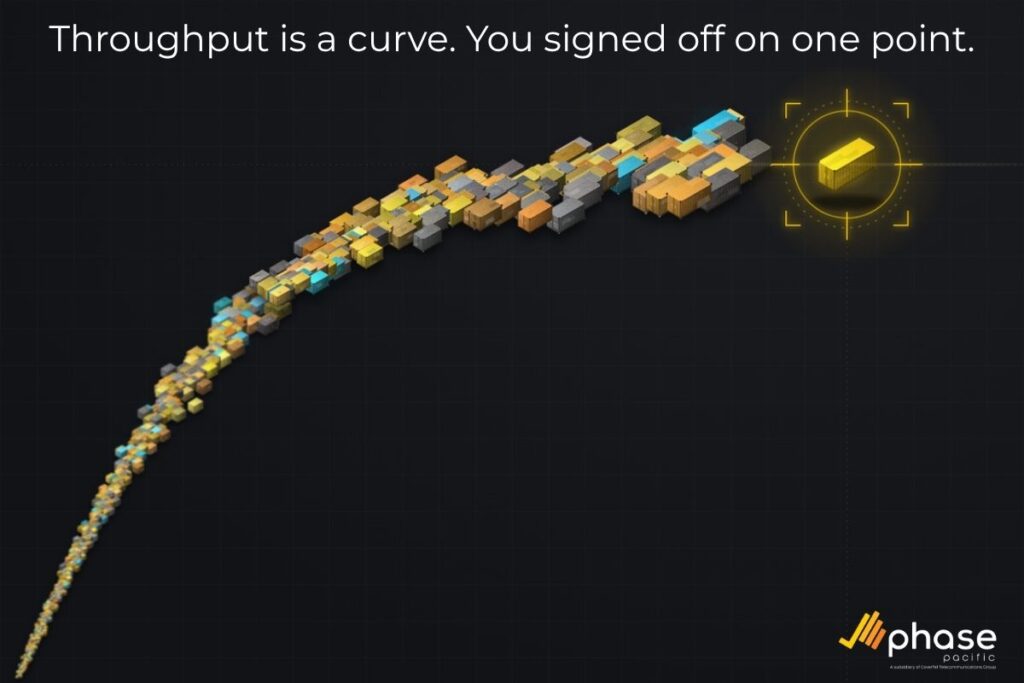
A team signs off a new firewall at 100 Gbps. The lab’s report is thorough, every frame size in a table, and the 64-byte row sits at a fraction of that figure. The change ticket gets one line, and the line says 100 Gbps. Six weeks into production the box is dropping traffic, and the post-mortem clears the device. Production ran heavy on small packets, DNS and API chatter, and the number everyone remembered came from the large-frame row.
The peak is the number that sticks
A ticket field holds one number. It should hold the lowest row of the sweep, and almost nobody puts it there. The peak is what the datasheet quotes, so the peak is what gets remembered.
Packets, not tonnes, set the limit
Picture a sorting centre rated at 100 tonnes a day. On parcels it hits the figure easily. On postcards the same tonnage means millions more items, each one read and sent down its own chute, so the centre is swamped long before the scales say it’s full. A firewall handles every packet the way that centre handles every item. The limit was always the item count.
148.8 million a second versus 8.1 million
The numbers show how lopsided it gets. A 64-byte frame occupies 84 byte-times on the wire once 20 bytes of preamble and inter-frame gap are counted, so a 100 Gbps link carries about 148.8 million of them a second. At 1518 bytes the same link carries about 8.1 million. Nothing on the wire demands more packets a second than 64-byte frames do. That makes the 64-byte result the worst case, and any real mix of sizes should do at least as well.
The sweep is standard, so lead with it
The sweep that produces the row has been standard since RFC 2544 in 1999. The lab did the work and printed the data, yet none of it survived the cut-and-paste into the change ticket.
Report layout plays a part, because page one is what gets copied from. I’d put the full sweep there with the lowest row marked, and leave the peak for the body.
Where the floor stops holding
The floor has limits, and I’ll own them. It holds only when the curve doesn’t dip somewhere in the middle, and only the full sweep can tell you that. A firewall also does extra work each time a new connection starts, and the sweep never tests that. The lowest row is the number to carry when only one can travel, and it doesn’t replace the curve.
Traffic Generation | Application Testing Solutions | Contact us
Sign up for our newsletter | Apposite Technologies