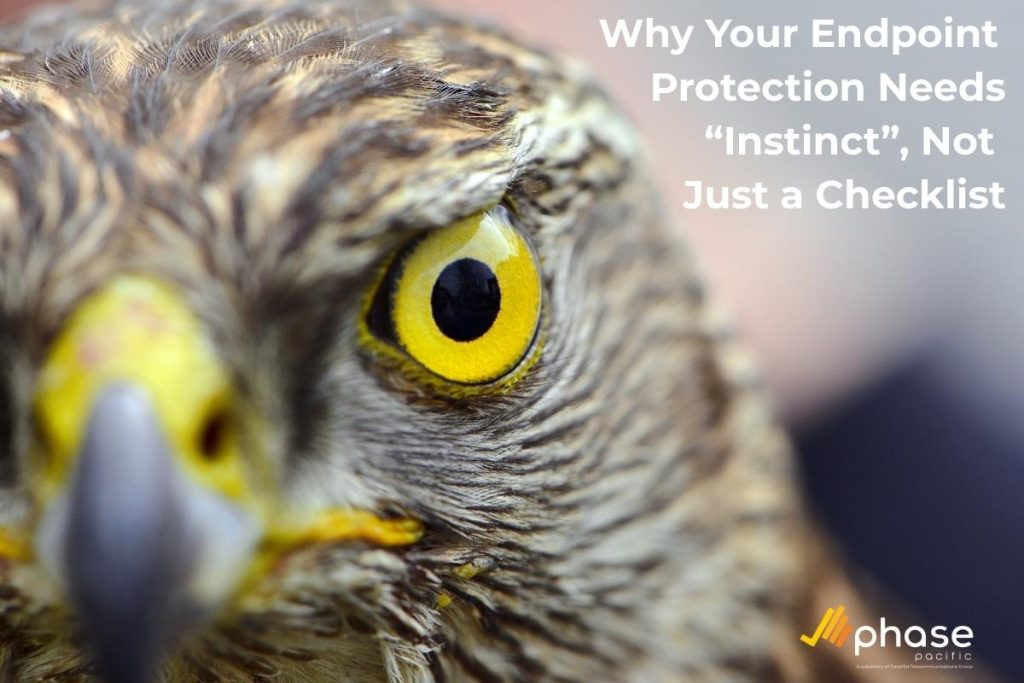
When you are shopping for cybersecurity today, the letters “AI” are absolutely everywhere. Every antivirus vendor has it. Everyone claims theirs is the smartest. And if you’re a business leader trying to lock down your network, it all starts to sound like static.
But here’s the uncomfortable truth your security vendor might not mention: I can tell you that most “AI” is actually pretty basic.
Most of what is sold as “Artificial Intelligence” in the endpoint protection market is just standard “Machine Learning.” That’s a fancy way of saying the software has memorised a list. It’s like a student who memorised every answer in the textbook but has no idea how to actually solve a problem.
If the test questions change even slightly, that student fails.
The “Test” Changes Every Morning
In the world of cyber threats, the “test” doesn’t just change once a year. It changes every single morning.
Hackers know that traditional security tools are looking for specific “fingerprints” (file names, code snippets, or known bad signatures). So, they have adapted. They use automation to slightly tweak their malware, sometimes thousands of times a day. They change the disguise, swap the file name, or alter the code just enough to look “new.”
If your Endpoint Protection is relying on that “memorised textbook,” it’s going to miss these new variants. This is what we call the “Morphing Malware Problem.”
From Plan B to Plan A
We recently discussed How to Build a Ransomware Strategy Focused on Instant Recovery, covering the crucial steps to take after an incident occurs. That is your safety net—your “Plan B.”
But today, we want to focus on “Plan A”: making sure you never have to use that recovery strategy in the first place. To do that, you need a tool that doesn’t just memorise the old threats, but one that can predict the new ones.
Moving from Memorisation to Understanding

Instead of looking for a specific file name or a known “bad guy,” Deep Learning analyses the “DNA” of the file. It looks at millions of tiny attributes—the file structure, the coding style, the way it attempts to run—to understand the intent behind the code.
It doesn’t care if the file is brand new. It doesn’t care if it was created five minutes ago. It looks at the code and essentially says: “I’ve never met you, but I know exactly what you are. You’re malicious. Blocked.”
Why “Instinct” Wins
Okay, the tech is cool, but how does this translate to better business for you? Why should a manager care about “Deep Learning” versus “Machine Learning”?
It comes down to three realities of modern business:
- Full Protection, Even When Offline (The Remote Work Fix)
Most traditional AI relies on the cloud. It needs to “phone home” to check its checklist against a central database. But what happens when your sales director is on a plane? Or working in a coffee shop with spotty Wi-Fi? Because “instinct” lives right on the device (it’s a tiny, highly efficient model), your laptops are protected everywhere. Online, offline, or in a tunnel—the protection never turns off. - It Stops Threats Before They Start
Many security tools are reactive. They have to let a file run for a few seconds to see if it starts doing something bad (like encrypting files) before they stop it. By then, damage might already be done. Because Deep Learning analyses the DNA of the file, it can predict and block attacks pre-execution. It stops the threat at the front door, not after it’s already inside the house. - It Reduces Noise
A system that “guesses” too often creates false alarms. Your IT team (or ours) ends up chasing ghosts, wasting time investigating safe files that just looked weird. Deep Learning is incredibly accurate, meaning fewer false alarms and more focus on real threats.
Beyond the Checklist
You wouldn’t hire an employee who freezes up the moment something unexpected happens. You hire people who can think on their feet and adapt.
Don’t accept anything less from your security software.
You’ve already got your “Plan B” (Instant Recovery) ready. Now, let’s lock down your network with the industry’s best “Plan A.” Ready to move beyond the checklist? I would love to help you build an endpoint defense with real instinct.
Sophos Endpoint Brochure | Services | Contact us
Sign up for our newsletter